
Kubotor Malware Analysis Professional
Windows malware triage, behavioural analysis, reverse engineering, debugging, unpacking, shellcode, detection and reporting.
Static & dynamic analysis
Triage and analyse malware safely — from file inspection to sandboxed behavioural analysis.
Reverse engineering
Disassemble and debug binaries to understand exactly what malicious code does.
Evasion & unpacking
Defeat packing, obfuscation, and anti-analysis tricks used by modern malware.
IOCs & reporting
Extract indicators of compromise and deliver actionable threat intelligence.
A 70% hands-on programme with one guided investigation per module. You build an isolated lab and work through the full analysis workflow — static triage, behavioural and network analysis, PE analysis, Ghidra, x64dbg, unpacking, shellcode, malicious documents, anti-analysis and injection — ending in YARA detections, ATT&CK mapping and a complete report.
Malware categories, infection chains and the static/dynamic/code-analysis approaches.
Building and verifying an isolated, network-controlled analysis environment.
How malware executes, persists and communicates on Windows.
Reading and tracing basic malware-relevant assembly routines.
Producing a static triage profile without executing the sample.
Executing a controlled sample and building a host-behaviour timeline.
Reconstructing malware communication and extracting network indicators.
Inspecting PE structures and execution-relevant anomalies.
Reverse engineering important functions and documenting malware logic.
Controlling malware execution and verifying hidden functionality.
Recovering an analysable executable from a packed sample.
Extracting and explaining embedded shellcode behaviour.
Analysing a document or script infection chain and recovering its payload.
Neutralising anti-analysis controls and tracing an injection workflow.
Creating detection content and a stakeholder-ready report.
Completing and defending an end-to-end malware-analysis investigation.
SOC Analysts
Malware triage, alert validation and behavioural investigation of suspicious files.
Incident Responders
Investigating malicious files and compromised systems during and after incidents.
DFIR & Threat Intel Analysts
Malware artefact identification, capability analysis and behavioural mapping.
Researchers & Pentesters
Reverse engineering, payload behaviour analysis and defensive detection awareness.
70% hands-on
Practical-heavy delivery — one guided investigation per module in an isolated lab.
Industry toolchain
FLARE-VM, REMnux, Ghidra, x64dbg, PEStudio, YARA, FakeNet-NG and more.
Detection & ATT&CK
Turn analysis into YARA rules and MITRE ATT&CK mappings, not just findings.
Report-ready
Produce professional technical and executive malware-analysis reports.
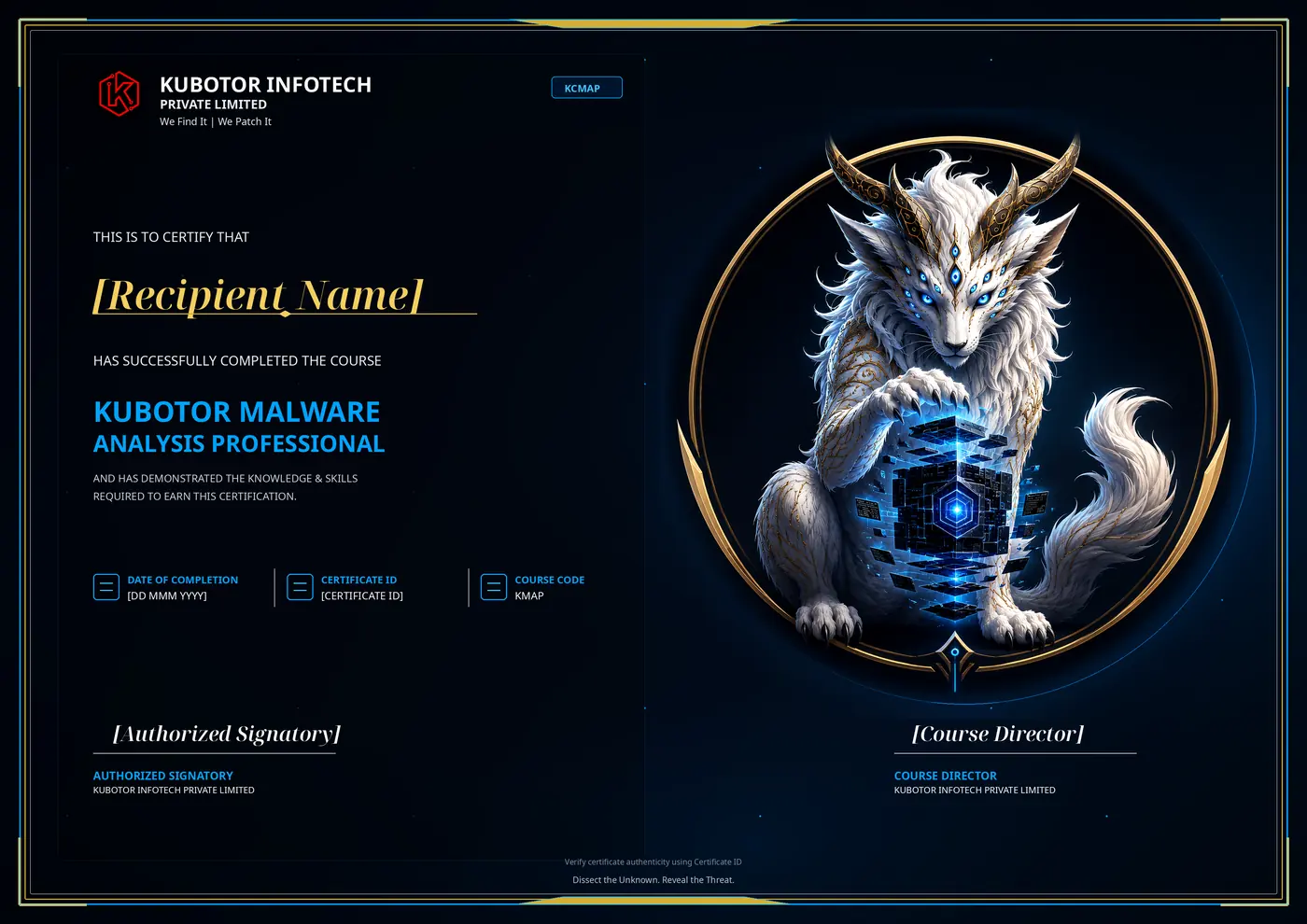
Completing this programme earns a formally issued, verifiable Kubotor credential. Two levels of recognition are available.
Certificate of Completion — Kubotor Malware Analysis Professional
Awarded to every participant who fulfils the prescribed learning modules, practical laboratory activities, and course-completion requirements. Confirms you have completed the Kubotor Malware Analysis Professional programme in full.
KCMAP — Kubotor Certified Malware Analysis Professional
The professional certification. Earned by passing a separate skills assessment that tests applied malware analysis — from static and dynamic triage to full reverse engineering. KCMAP demonstrates competence to employers and clients.
Every certificate carries a unique ID and verification reference, so its authenticity can be independently confirmed.
Interested in this course? Our team will reach out within 1 business day.
Enquire Now